Case study專案案例
Built a crisis-alert system that outpaced a 150-person monitoring team危機預警系統,偵測速度超越150人監控團隊
Combined NLP classification with time-series forecasting to identify rapidly escalating reputation risks before they became visible through online conventional monitoring.結合自然語言處理(NLP)與時間序列預測技術,搶先在傳統網路監控偵測到之前,辨識出正快速升溫的風險。
Outcome成果
3–6 hours earlier crisis detection提早3–6小時偵測到危機
- Client客戶
- Global e-Commerce全球電商平台
- Role角色
- Lead Data Scientist首席資料科學家
- Timeframe期間
- 20202020
Situation
A global e-commerce company needed earlier warning of emerging events that could affect its operations or reputation. The trigger was a period, during the COVID-19 pandemic, when a sharp rise in price-gouging on essential health and hygiene products on the platform drew significant regulatory and media scrutiny. Detection at the time relied on a manual monitoring team of roughly 150 people tracking online mentions, so by the time an issue became visible, exposure had often already grown considerably.
The initial ask was straightforward — monitor brand-related conversation online and alert PR and strategy teams when negative volume rose — but volume and average sentiment alone made poor early-warning signals: a global brand generates heavy discussion every day, most of it ordinary background noise, while genuinely risky events could start small and accelerate quickly around a narrow topic or platform.
Strategy
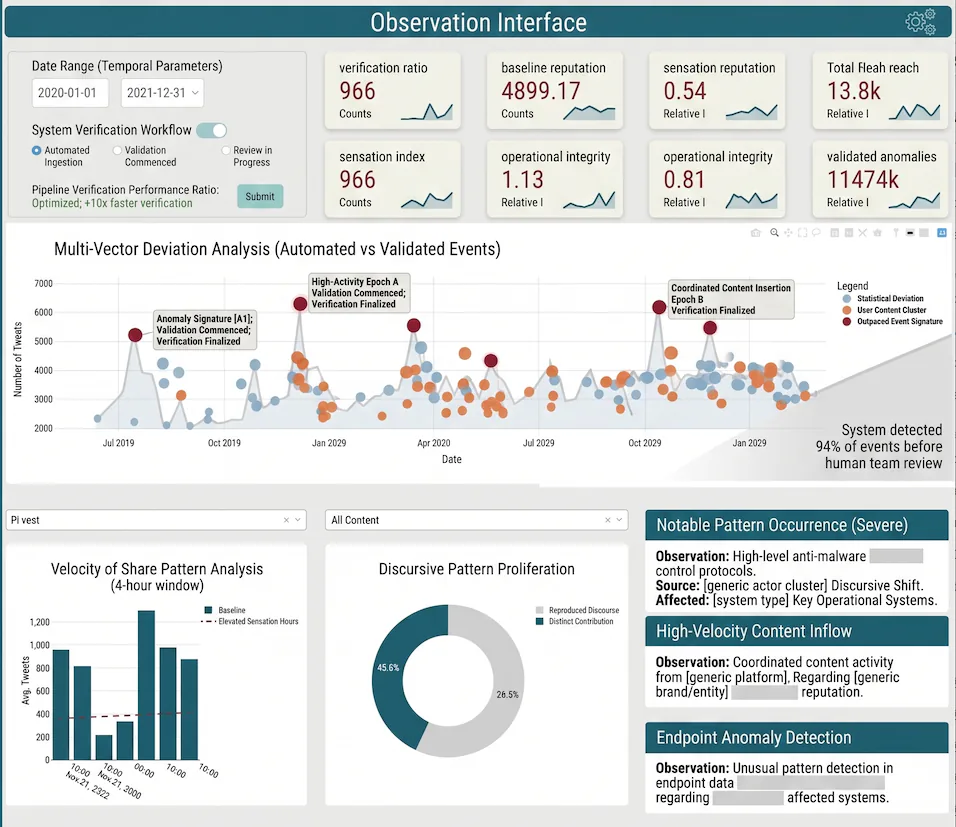
I scoped and led the design of a crisis detection and alerting system that combined NLP classification with time-series forecasting. Working with the client’s brand and communications teams, I translated a broad monitoring request into three measurable capabilities: identifying potential crisis events, forecasting their trajectories, and converting those forecasts into signals the business could act on.
1. Identifying potential crisis events using NLP.
The first challenge was limited training data. Crisis events vary considerably by topic, sentiment, product category, platform, and external context. A small static sample could not adequately represent the range of scenarios the classifier would encounter in production.
Rather than training a crisis classifier directly on this limited sample, I designed a two-stage approach. We first trained a broader negative-sentiment detector and used it to identify a substantially larger pool of potentially relevant content. That expanded dataset was then reviewed and labelled to train the more targeted crisis-event classifier.
This approach increased the diversity of the training data and reduced the risk of producing a model that performed well on a narrow offline test set but failed to recognise previously unseen crisis patterns in production.
2. Forecasting how events were likely to develop.
Identifying negative content was not sufficient. Static sentiment scores and raw mention counts generated false alarms for high-volume topics while missing smaller issues that were beginning to accelerate.
I therefore designed a time-series forecasting layer that used each topic’s recent activity to project its likely trajectory. The system flagged topics whose forecast activity was accelerating sharply relative to their own historical baseline.
This distinction was central to the solution: the system assessed where a topic was heading, rather than reacting only after negative conversation had already reached a fixed threshold.
3. Translating model outputs into operational signals.
Raw model probabilities would have required business users to interpret the analytics themselves. I converted the classification and forecasting outputs into a set crisis-risk metrics and topic category that PR, brand, and CRM teams could use directly.
The resulting alerts gave teams a common basis for deciding whether to escalate an issue, adjust a live campaign, prepare a response, or continue monitoring—without requiring them to understand the underlying models.
Result
The system identified critical events approximately 3–6 hours earlier than the existing 150-person manual monitoring process, giving PR and brand teams a meaningful window to respond before an issue reached wider visibility.
Its outputs were incorporated into CRM and campaign-response decisions, enabling the client to adjust messaging or pause campaigns associated with an emerging issue instead of reacting after the event had already escalated.
情境與背景
一家全球電子商務平台需要針對可能影響其營運或聲譽的新興事件,建立更早期的預警機制。
觸發此需求的起因是在 COVID-19 疫情期間,該平台上基本健康與衛生用品的哄抬物價現象激增,引發了監管機構與媒體的高度關注。 當時的偵測作業仰賴一個約 150 人的團隊手動監控網路聲量,當問題浮上檯面時,其曝光度通常已經大幅擴張。
最初的要求很直接:監控網路上與品牌相關的討論,並在負面聲量上升時發出警報給公關與策略團隊。然而,單靠聲量和情感分析無法提供良好的早期預警訊號: 一個全球品牌每天都會產生大量的討論,其中大部分是普通的背景雜音,而真正具風險的事件可能起初規模很小,卻會圍繞著特定主題或傳播途徑(例如意見領袖或特定平台)迅速延燒。
策略與執行
我評估了專案範圍並主導一套危機偵測與警報系統的設計,該系統結合了自然語言處理 (NLP) 分類與時間序列預測。透過與客戶的品牌及公關團隊合作,我將廣泛的監控需求轉化為三項具體可衡量的能力: 識別潛在危機事件、預測其發展軌跡,以及將這些預測轉化為業務單位可採取行動的訊號。
一、利用NLP識別潛在危機事件
首要挑戰是訓練資料有限。危機事件在主題、情緒、產品類別、平台和外部環境上都有著巨大的差異。一個小型的靜態樣本無法充分代表分類器在實際環境中會遭遇的各種情境。
與其直接在這個有限的樣本上訓練危機分類器,我設計了一個兩階段的方法。我們首先訓練了一個更廣泛的負面情緒偵測器,並利用它來識別出數量更龐大、具潛在關聯性的內容。 接著,針對擴充後的資料集進行人工審查與標記,以此來訓練更具針對性的危機事件分類器。
這種做法增加了訓練資料的多樣性,並降低了一種風險:亦即產出一個在狹隘的離線測試集中表現優異,但在實際上線環境卻無法識別出前所未見危機模式的模型。
二、預測事件可能的發展趨勢
僅僅識別負面內容是不夠的。靜態的情緒分數、原始提及次數和分享內容的觸達率,容易對高聲量主題產生錯誤警報,同時卻漏掉正在開始加速發酵的小型議題。
因此,我設計了一個時間序列預測層,利用每個主題分類近期的活動量來預測其可能的發展軌跡。系統會標記出那些相較於自身歷史基準線,預測活動量呈現急遽加速的主題。
這項差異是整個解決方案的核心:系統評估的是主題未來的走向,而不是等負面討論已經達到固定閾值後才被動做出反應。
三、將模型輸出轉化為可執行的營運指標
若直接提供模型的原始機率,業務使用者仍須自行解讀分析結果。因此,我將分類與預測的輸出結果,轉化為一組危機風險指標與主題分類,讓公關、品牌與CRM團隊可以直接使用。
由此產生的警示,讓各團隊擁有共同的判斷依據,讓他們能決定是否要升級問題、調整正在進行的行銷活動、準備應對方案,或是繼續監控——而無需去了解底層模型的運作原理。
成果
該系統能比現有 150 人的手動監控流程提早約 3 到 6 小時識別出關鍵事件,為公關與品牌團隊爭取到寶貴的反應時間,得以在問題引發廣泛關注前做出應對。
系統的輸出結果被整合到 CRM 與行銷活動回應的決策中,使客戶能夠主動調整溝通訊息,或暫停與新興問題相關的行銷活動,取代了過去只能在事件升級後才被動反應的狀況。