Case study專案案例
Award-winning transaction monitoring system for a financial institution為金融機構打造的防洗錢交易監控系統,榮獲獎項肯定
Built and shipped a production monitoring system from an undefined brief with no labelled data — later named “Best AML/CFT Data, Analytics & Visualisation Solution” at the Regulation Asia Awards for Excellence 2023.在需求未明、亦無標註資料的情況下,打造一套正式運作的交易監控系統,其後在《2023 Regulation Asia Awards》中榮獲「最佳洗錢防制/打擊資恐 (AML/CFT) 數據、分析與視覺化解決方案」獎項。
Outcome成果
Regulation Asia Awards 2023Regulation Asia Awards 2023
- Client客戶
- Financial Institution金融機構
- Role角色
- Lead Data Scientist & Full-Stack Developer首席資料科學家暨全端工程師
- Timeframe期間
- 2022-20252022-2025
Situation
A financial institution needed a production-ready transaction monitoring system within six months, under regulatory pressure to demonstrate compliance.
The starting point was closer to a blank page than a spec: there was no agreed definition of the risks the system should monitor, no confirmed inventory of source data, no performance framework, and no labelled dataset against which to train or evaluate a model.
Before developing any detection logic, we therefore had to define the monitoring problem itself: which behaviours required coverage, what evidence analysts would need, and how the resulting decisions could be explained to the regulator.
Strategy
Working with a cross-functional team of data engineers and compliance specialists, I led the design of the detection models and alert-triage workflow at the core of the system. I structured the solution around three connected components: a rules-based detection engine, an unsupervised anomaly-detection layer, and a human-in-the-loop workflow for reviewing and resolving alerts.
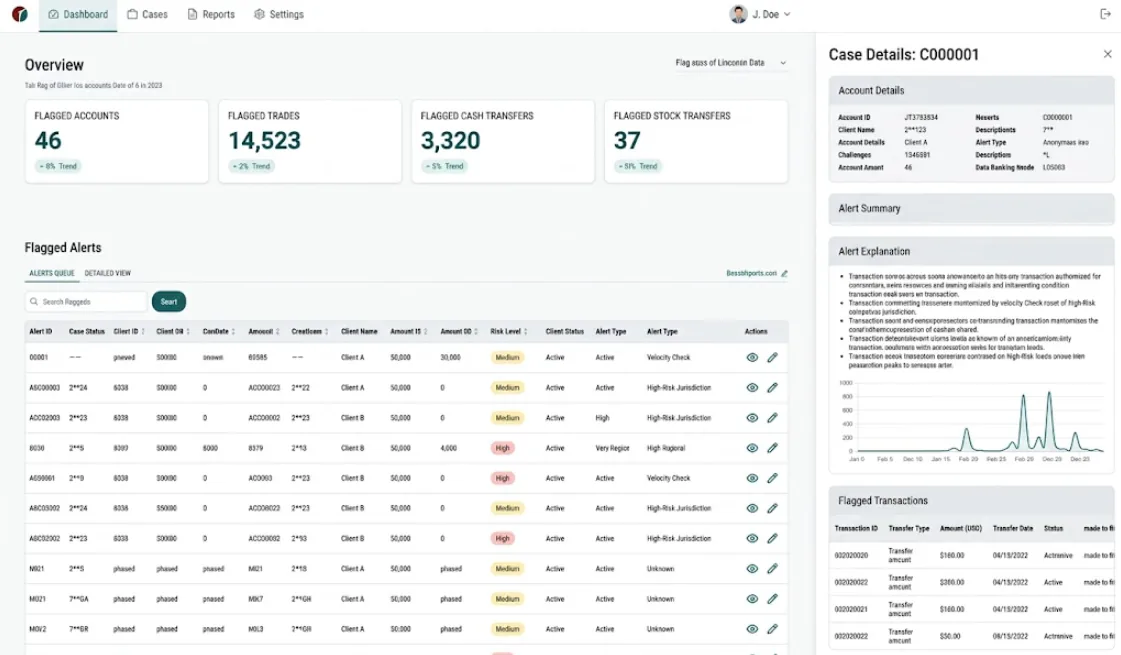
Reproduced mock-up of the original interface. It shows how prioritised alerts, account context, model explanations, transaction history, and analyst actions were brought into one auditable workflow.
1. Translating regulatory requirements into detection rules
Without labelled outcomes, supervised learning was not a credible starting point. I first worked with the client’s compliance specialists to define what constituted suspicious activity, drawing on regulatory guidance and jurisdiction-specific requirements.
We translated those requirements into 16 financial crime typologies across three levels: customer, account, and transaction. Using data ingested and standardised from more than ten internal systems and external providers, I then designed the features and detection logic supporting each typology.
For example, the mule-account rule identified accounts where incoming funds were withdrawn unusually quickly relative to the account’s own historical behaviour. Using a dynamic baseline instead of a fixed threshold helped distinguish genuinely unusual activity from the normal behaviour of high-turnover accounts.
2. Extending coverage beyond known typologies
Rules provide strong coverage for known risks, but they cannot identify behaviours that have not already been defined. I therefore designed a complementary unsupervised anomaly-detection layer to surface statistically unusual activity even when it matched none of the 16 typologies.
This layer was intentionally designed as a discovery mechanism rather than a source of definitive conclusions. I made the precision trade-off explicit to the client: its outputs were hypotheses for analysts to investigate, not evidence that suspicious activity had occurred.
3. Turning model outputs into an operational workflow
Detection alone would not make the system operational. I designed the alert-triage workflow used by analysts to review flagged activity, including the supporting evidence shown for each alert, the available dispositions—close or escalate—and the audit trail required for regulatory review.
The wider team implemented this workflow as a web application. Outputs from both detection layers were fed into a single review queue, while analysts’ dispositions created a feedback loop for recalibrating rules and thresholds over time.
Result
The completed system was reviewed and accepted by the regulator. By 2025, it had been operating in production for more than three years, with compliance analysts using it daily to review, investigate, and resolve alerts.
The project turned an initially undefined regulatory requirement into an embedded operational capability, with explicit risk coverage, consistent analyst decisions, and a defensible audit trail.
The solution was subsequently named Best AML/CFT Data, Analytics & Visualisation Solution at the Regulation Asia Awards for Excellence 2023.
情境與背景
某金融機構面臨必須展現合規性的監管壓力,需要在六個月內建立一套可正式上線運作的交易監控系統。
專案初期幾乎是從零開始,而非依循既有的商業企劃書:系統應監控哪些風險尚無共識、來源資料尚未盤點確認、缺乏績效衡量框架,也沒有可用於訓練或評估模型的標註資料。
因此,在開發任何偵測邏輯之前,我們必須先定義「監控」這個問題本身:哪些行為需要納入涵蓋範圍、分析師需要哪些佐證資料,以及最終決策該如何向監理機關說明。
策略與執行
我與資料工程師及法遵專家組成跨職能團隊合作,主導了系統核心的偵測模型與警報分類 (Alert-triage) 工作流程設計。我將解決方案架構在三個相互連結的組件上:基於規則式偵測引擎(rule-based engine)、非監督式學習異常偵測模型(unsupervised-learning),以及供人工審查與處理警示的協作流程。
原始介面之重製示意圖。呈現如何將優先排序的警示、帳戶背景資訊、模型說明、交易紀錄與分析師操作,整合於單一可稽核的工作流程之中。
一、將監管要求轉化為偵測規則
在缺乏標記結果的情況下,監督式學習並非可靠的起點。我首先與客戶的合規專家合作,參考監管指南和特定司法管轄區的要求,定義了何謂「可疑活動」。
我們將這些要求轉化為涵蓋客戶、帳戶和交易三個層級的 16 種金融犯罪類型 (Typologies)。接著,我利用從十多個內部系統與外部供應商匯入並標準化的資料,為每種犯罪類型設計了專屬的特徵與偵測邏輯。
例如,針對人頭戶 (Mule-account) 的規則,會揪出相較於該帳戶自身歷史行為,匯入資金被異常快速提領的帳戶。使用動態基準線而非固定閾值,有助於將真正異常的活動與高周轉率帳戶的正常行為區分開來。
二、將涵蓋範圍擴展至已知犯罪類型之外
規則對於已知風險能提供強大的涵蓋範圍,但無法識別尚未被定義的行為。因此,我設計了一個相輔相成的非監督式學習異常偵測層,即使某些活動不符合那 16 種犯罪類型,也能將統計上的異常行為凸顯出來。
這一層的設計初衷是作為一種「發現機制」,而非提供最終結論。我向客戶明確說明了在準確度上的取捨:其輸出結果是供分析師調查的「假設」,而非已發生可疑活動的「證據」。
三、將模型輸出轉化為營運工作流程
單靠偵測功能無法讓系統順利運作。我設計了分析師用來審查標記活動的警報分類工作流程,包含每個警報顯示的佐證資料、可執行的處置方式(結案或升級),以及監管審查所需的稽核軌跡 (Audit trail)。
整個團隊將此工作流程實作為一個網路應用程式。兩個偵測層的輸出結果會匯入單一的審查佇列中,而分析師的處置結果則建立了一個回饋迴圈,以便隨時間持續重新校準規則與閾值。
成果
完成後的系統已通過監管機構的審查並獲認可。截至 2025 年,該系統已實際上線運作超過三年,合規分析師每天都使用它來審查、調查並處理警報。
該專案將最初定義不明的監管要求,成功轉化為深植企業內部的營運能力,並具備了明確的風險涵蓋範圍、一致的分析師決策流程,以及經得起檢驗的稽核軌跡。
此解決方案隨後更在 2023 年《Regulation Asia Awards》中,榮獲「最佳洗錢防制/打擊資恐 (AML/CFT) 數據、分析與視覺化解決方案」殊榮。